
Opens in a new tab

October 30, 2026

Particularly independent position: What should employers do now?

The Supreme Court's ruling on "particularly independent positions" has received considerable attention and sparked debate about the use of the exemption provisions in Chapter 10 of the Working Environment Act. Many businesses have employees who are exempt from the working hours provisions, and reports indicate that their use may be extensive.

The Supreme Court has now clarified which factors employers must take into account when assessing whether a position is «particularly independent». Flexible working hours, great responsibility and freedom to decide how the work is carried out are not sufficient. A key question is whether the employee actually has control over their own working hours and workload. The comprehensive assessment must also include external framework conditions. These may include deadlines, progress targets, requirements and limits from customers, external partners or projects, as well as requirements from public bodies or in regulations.

Document the foundation

The first step is to review existing classifications. Employers should make a specific assessment of each position and document the basis for the classification.
From an HR perspective, we believe it is important to map out how everyday work actually works. Some particularly useful questions are:
  • Who or what determines the workload this employee will have?
  • Can the employee actually postpone, delegate or reject work?
  • Who decides when the work will be carried out, and if so, which deadlines can be moved?
  • What happens in practice when the employee says that the workload is too heavy?

Mapping and relief

It is not necessarily enough to encourage the employee to speak up if the workload becomes too great. Such an invitation is not a real relief mechanism if no tasks are removed, no deadlines are changed and no additional capacity is added. In the webinar with Schjødt, both mapping and actual relief were therefore central themes.

 
You can watch the recording of Schjødt and BUHR's webinar here:

News from the HR competence center BUHR

Gain insight into how businesses work smarter with HR, leadership and organizational development. Here you will find customer stories, professional articles, current topics and upcoming seminars from BUHR.

Customer story

Dag Martin Smørdal, Konsernleder SR Group og Arild Simonsen, HR Manager BUHR.

November 18, 2026

SR Group: A complete HR department behind the scenes

SR Group is a full-service provider of transport and logistics services that handles the entire value chain for its customers, from ordering and planning to warehousing, customs and transport.

Read more

News

Bjørg Ueland

November 10, 2026

BUHR is a gazelle company for the fifth year in a row

When Bjørg Ueland founded BUHR in 2018, she wanted to challenge the traditional way of working with HR. Eight years later, the company has 50 employees and over 50 active clients. Now BUHR can celebrate its fifth consecutive year as a gazelle company.

Read more

News

November 2, 2026

Exciting leadership role for those who want to build strong customer relationships and create growth

VACANCY: BUHR is ready for the road ahead! After a period of restructuring and a new structure for BUHR, we are now looking for a results-oriented manager for our department in Stavanger.

Read more

Arrangement

Frokostseminar med BUHR og Schjødt, illustrasjonsfoto med to logoer.

October 30, 2026

Breakfast seminar: How to handle challenging employees and employees in "particularly independent positions"«

How do we handle demanding personnel cases before they escalate? And what does the recent Supreme Court ruling on a particularly independent position mean for employers? On Wednesday, November 18, BUHR and the law firm Schjødt invite you to a breakfast seminar in Stavanger.

Read more

Technical article

October 30, 2026

Particularly independent position: What should employers do now?

The Supreme Court's ruling on "particularly independent positions" has received considerable attention and sparked debate about the use of the exemption provisions in Chapter 10 of the Working Environment Act. Many businesses have employees who are exempt from the working hours provisions, and reports indicate that their use may be extensive.

Read more

Arrangement

October 19, 2026

Webinar: New Supreme Court ruling on "particularly independent position"«

The ruling has great practical significance for businesses that currently exempt employees from working time rules and overtime pay on this basis. On Wednesday, October 21, BUHR and the law firm Schjødt invite you to a free webinar where we will review the ruling and what businesses should do now.

Read more

Technical article

August 26, 2026

Home office – from principles to good practice

How much home office is really right? More and more companies are reevaluating the arrangement. The answer is rarely either or, but it requires clear choices, good justifications and a practice that actually works.

Read more

Technical article

June 23, 2026

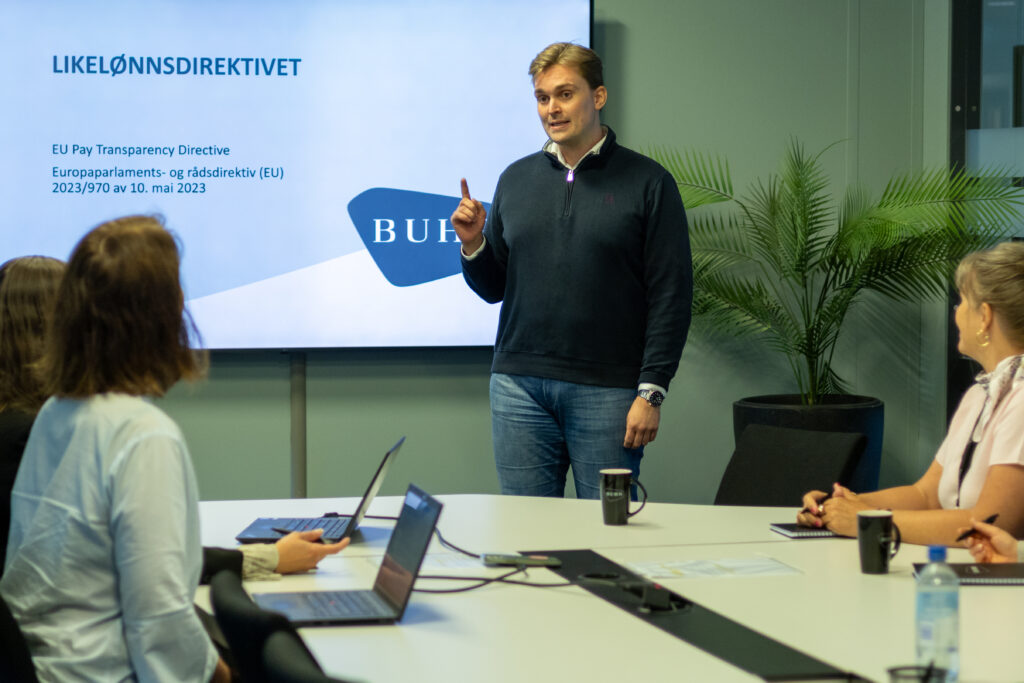
While we wait for the Equal Pay Directive – what already applies today?

The EU's Pay Transparency Directive, or the Equal Pay Directive in Norwegian, was adopted in 2023, and the deadline for implementation in member states was June 7, 2026 at the latest. What is the status now that this deadline has passed?

Read more

Technical article

May 13, 2026

The holiday dilemmas

Summer is approaching, and now comes the time for vacation planning – and all the small and big questions that come with it. Has everyone remembered to apply? Who gets vacation when – is the plan working? Is the new employee actually entitled to three weeks in July? And what happens if someone gets sick during the vacation?

Read more

Technical article

April 7, 2026

The 2026 wage settlement – what is happening, and what does this mean for you and your company?

The 2026 wage settlement is a main settlement, which is the most comprehensive of the two types of wage settlements we have in Norway. This means that the parties are not only negotiating about wages, but about the entire content of the collective agreements. This means that the negotiations can also include working hours, overtime pay, welfare leaves and other terms.

Read more