
Opens in a new tab

March 3, 2025

Handling whistleblowing cases: A key to trust and safety in the workplace

Whistleblowing cases can be challenging for both employers and employees, and good handling is crucial to ensuring a safe workplace and fair treatment for all parties. But how do we handle these cases well?

In accordance with Chapter 2A of the Norwegian Working Environment Act, employees, including contracted personnel, have the right to report objectionable conditions in the company. Taking advantage of the opportunity to report when you see, hear or experience something objectionable contributes to creating a healthy and responsible corporate culture.

The importance of good handling

Handling whistleblowing cases in an orderly manner strengthens trust in the work environment, reduces the risk of conflicts and helps prevent serious situations. It shows that the organization takes responsibility and prioritizes both employee safety and the integrity of the organization.

By having clear guidelines and a professional approach, you lay the foundation for a healthy and open culture where employees dare to speak up about objectionable matters.

Clear routines

To create predictability and security for all parties involved, it is crucial to have clear guidelines for how reports should be reported and processed. The Working Environment Act, §2 A-6, describes the employer's obligation to prepare written procedures for internal reporting, and that these should be easily accessible to all employees in the company.

BUHR

Take the warning seriously

Whistleblowers must feel confident that their report will be handled confidentially and with respect. All reports, no matter how small they may seem, must be taken seriously. Employers have a responsibility to ensure that the reporting channel is available, and that employees can report anonymously if they wish. At the same time, the person being reported must be assured of a fair process.

Conduct a thorough and objective assessment

When a report is received, it must be thoroughly investigated. In particularly complex cases, it may be appropriate to use an independent third party to ensure an objective assessment.

Maintain confidentiality

Confidentiality is a key word in whistleblowing cases, to protect both the whistleblower and the person being reported. Information about the case should only be shared with people directly involved in handling it.

Communicate clearly

Keep all parties involved informed throughout the process. The whistleblower should be informed about how the case will be handled and what they can expect. It is also important to inform them that a case will be handled fairly and in line with applicable regulations.

Follow up after conclusion

Once the case has been resolved, it is important to follow up on the actions taken and evaluate whether the whistleblowing procedures are working as they should. While the details of individual cases must be handled discreetly, organizations can benefit from communicating what they have learned and what actions are being taken to improve the work environment.

Handling whistleblowing cases is more than just a legal obligation – it's about building a culture where everyone feels safe enough to speak up and ensuring a fair and inclusive work environment.

Would you like more specific advice or help with developing notification routines?

Whistleblowing cases can be demanding for both employers and employees, and good handling is crucial to ensuring a safe workplace and fair treatment of all parties.

Do you need more specific advice or help with developing reporting routines? Get in touch!

Contact us

News from the HR competence center BUHR

Gain insight into how businesses work smarter with HR, leadership and organizational development. Here you will find customer stories, professional articles, current topics and upcoming seminars from BUHR.

News

Bjørg Ueland

November 10, 2026

BUHR is a gazelle company for the fifth year in a row

When Bjørg Ueland founded BUHR in 2018, she wanted to challenge the traditional way of working with HR. Eight years later, the company has 50 employees and over 50 active clients. Now BUHR can celebrate its fifth consecutive year as a gazelle company.

Read more

News

November 2, 2026

Exciting leadership role for those who want to build strong customer relationships and create growth

VACANCY: BUHR is ready for the road ahead! After a period of restructuring and a new structure for BUHR, we are now looking for a results-oriented manager for our department in Stavanger.

Read more

Arrangement

Frokostseminar med BUHR og Schjødt, illustrasjonsfoto med to logoer.

October 30, 2026

Breakfast seminar: How to handle challenging employees and employees in "particularly independent positions"«

How do we handle demanding personnel cases before they escalate? And what does the recent Supreme Court ruling on a particularly independent position mean for employers? On Wednesday, November 18, BUHR and the law firm Schjødt invite you to a breakfast seminar in Stavanger.

Read more

Technical article

October 30, 2026

Particularly independent position: What should employers do now?

The Supreme Court's ruling on "particularly independent positions" has received considerable attention and sparked debate about the use of the exemption provisions in Chapter 10 of the Working Environment Act. Many businesses have employees who are exempt from the working hours provisions, and reports indicate that their use may be extensive.

Read more

Arrangement

October 19, 2026

Webinar: New Supreme Court ruling on "particularly independent position"«

The ruling has great practical significance for businesses that currently exempt employees from working time rules and overtime pay on this basis. On Wednesday, October 21, BUHR and the law firm Schjødt invite you to a free webinar where we will review the ruling and what businesses should do now.

Read more

Technical article

August 26, 2026

Home office – from principles to good practice

How much home office is really right? More and more companies are reevaluating the arrangement. The answer is rarely either or, but it requires clear choices, good justifications and a practice that actually works.

Read more

Technical article

June 23, 2026

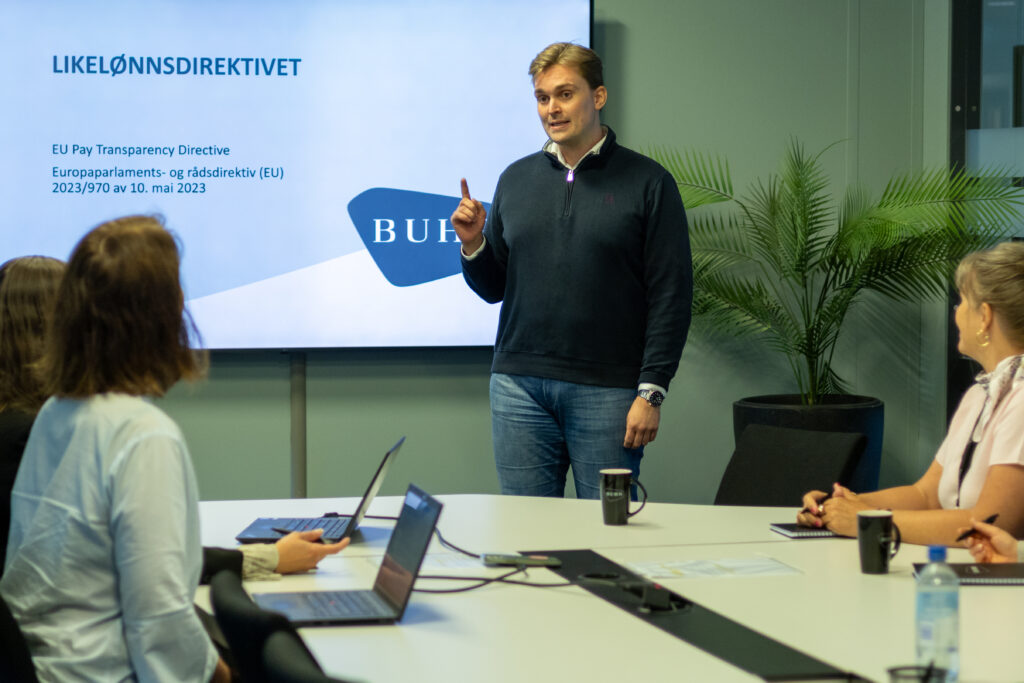
While we wait for the Equal Pay Directive – what already applies today?

The EU's Pay Transparency Directive, or the Equal Pay Directive in Norwegian, was adopted in 2023, and the deadline for implementation in member states was June 7, 2026 at the latest. What is the status now that this deadline has passed?

Read more

Technical article

May 13, 2026

The holiday dilemmas

Summer is approaching, and now comes the time for vacation planning – and all the small and big questions that come with it. Has everyone remembered to apply? Who gets vacation when – is the plan working? Is the new employee actually entitled to three weeks in July? And what happens if someone gets sick during the vacation?

Read more

Technical article

April 7, 2026

The 2026 wage settlement – what is happening, and what does this mean for you and your company?

The 2026 wage settlement is a main settlement, which is the most comprehensive of the two types of wage settlements we have in Norway. This means that the parties are not only negotiating about wages, but about the entire content of the collective agreements. This means that the negotiations can also include working hours, overtime pay, welfare leaves and other terms.

Read more

Technical article

Medarbeidersamtaler Vera og Amelie

January 26, 2026

Why performance reviews are important – and how to get real value from them?

Good leadership is often the sum of good, meaningful conversations. The prerequisite is that they are done systematically, with a clear framework and the right support.

Read more